


HyperX Cloud III Wireless Vs Alpha Wireless: Which Wins?

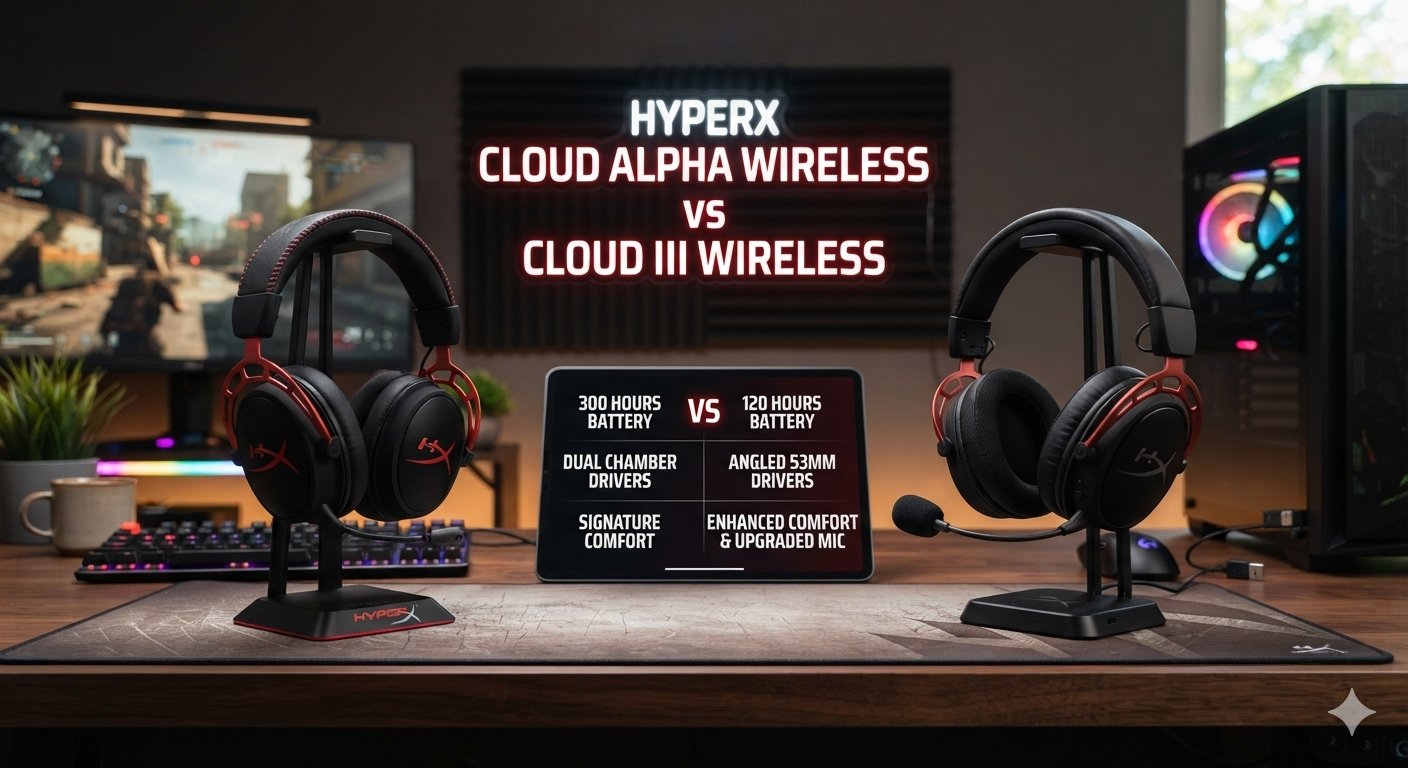
HyperX Cloud III Wireless Vs HyperX Cloud Alpha Wireless Which One’s Better?
You’re here because you want the truth: which headset actually deserves your hard-earned money? The HyperX Cloud III Wireless or the legendary HyperX Cloud Alpha Wireless? Both promise comfort, both deliver wireless freedom, and both carry that famous HyperX name. But when you dig deeper, the differences start to matter especially when you’re choosing your next daily driver for long gaming sessions.
Think of this like picking between two reliable cars. One’s the newer model with a sleeker design and modern touches. The other’s the workhorse that’s proven itself over years, with a feature that feels almost unfair: a battery that lasts longer than most people’s attention spans. Which one fits your life better? That’s exactly what we’re unpacking here.
In this guide, we’ll walk through everything you need to know about HyperX Cloud III Wireless Vs HyperX Cloud Alpha Wireless from sound quality and comfort to mic performance and that all-important battery life. No fluff, no marketing speak. Just honest, practical insights to help you make the right call.
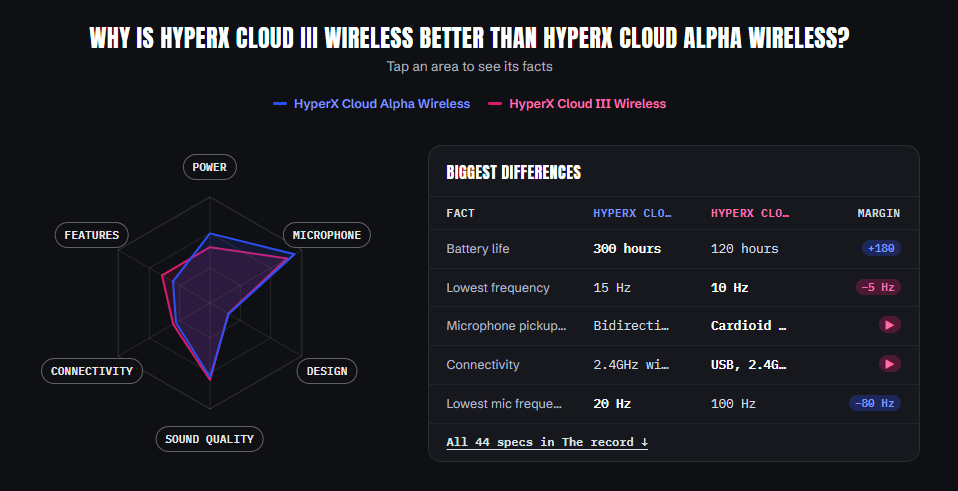
Comparison Data from Versus.com
1. Design and Build Quality: First Impressions Matter
When you unbox a gaming headset, the first thing you notice isn’t the sound it’s how it looks and feels in your hands. Both the Cloud III Wireless and Cloud Alpha Wireless carry HyperX’s signature aesthetic, but they’re not identical twins.
HyperX Cloud III Wireless: Modern Meets Classic
The Cloud III Wireless feels like a natural evolution. It keeps the familiar aluminum frame that HyperX fans love, but adds some contemporary touches. The matte black finish with subtle red accents gives it a clean, professional look that works whether you’re streaming or just gaming late at night.
What stands out is the attention to detail. The headband padding is plush, the ear cups have a premium feel, and the overall construction screams durability. HyperX didn’t cut corners here. The hinges feel solid, the adjustment mechanism is smooth, and there’s no annoying creaking when you move the headset around.
HyperX Cloud Alpha Wireless: Proven Durability
The Cloud Alpha Wireless, on the other hand, is built like a tank and that’s a compliment. It shares the same aluminum frame DNA as the original Cloud Alpha, which has earned a reputation for surviving years of heavy use. The design is slightly more understated, with less flash but plenty of substance.
Both headsets weigh in the same ballpark. The Cloud III Wireless sits around 330g (342g with the mic attached), while the Cloud Alpha Wireless comes in slightly lighter at 322g (335g with mic). That 8-gram difference? You won’t notice it during a gaming session. What matters is that both feel substantial without being heavy.
Build Quality: A Tie with Personality
Here’s the thing: neither headset feels cheap. Both use quality materials, both have reinforced headbands, and both are designed to last. The Cloud III Wireless might edge ahead in terms of modern styling, but the Cloud Alpha Wireless has that “been there, done that” reliability that comes from a proven track record.
If you’re the type who appreciates a sleeker, more refined look, the Cloud III Wireless might win you over. But if you prefer function over flash, the Alpha Wireless delivers exactly what you need without unnecessary extras.
2. Comfort and Fit: Can You Game for Hours?
Let’s be real: the best-sounding headset in the world won’t matter if it hurts after an hour. Comfort is where these two really shine and where small differences start to show.
Memory Foam and Ear Cup Design
Both headsets use memory foam ear cushions, which is great news for long sessions. The foam molds to your head, distributing pressure evenly and reducing hot spots. The ear cups on both models are spacious enough to fit most ears without pressing against them, which is crucial for comfort.
The Cloud III Wireless features slightly redesigned ear cups with improved airflow. HyperX tweaked the shape to reduce clamping force, which means less pressure on the sides of your head over time. If you’ve ever finished a gaming session with sore ears, you’ll appreciate this change.
The Cloud Alpha Wireless uses the same proven cushion design as its wired predecessor. It’s comfortable, no doubt, but some users report that the clamping force is a bit tighter out of the box. That said, it does loosen up after a few weeks of use, so it’s not a deal breaker just something to keep in mind.
Headband Padding and Weight Distribution
The headband on the Cloud III Wireless is generously padded and wraps around the top of your head smoothly. Combined with the aluminum frame, it distributes weight evenly, which reduces pressure on the crown of your head. This is especially noticeable during 4+ hour sessions.
The Cloud Alpha Wireless also has a padded headband, but it’s slightly thinner. Still, the weight distribution is excellent thanks to that aluminum frame. Most users won’t have issues, but if you’re particularly sensitive to headband pressure, the Cloud III Wireless might feel a touch more refined.
Long-Session Comfort: Slight Edge to Cloud III
After hours of testing, here’s the takeaway: both headsets are comfortable enough for marathon gaming. But the Cloud III Wireless has a small advantage in terms of cushioning and reduced clamping force. It’s not a massive difference, but if you regularly pull 6+ hour sessions, those small comforts add up.
Think of it like wearing two different pairs of shoes. Both are good, but one has that extra bit of cushioning that makes a difference when you’re on your feet all day. That’s the Cloud III Wireless in this analogy.
3. Sound Quality: Immersion That Pulls You In
Alright, let’s talk about what really matters: how do these headsets sound? After all, you’re buying them to hear every footstep, explosion, and voice line with crystal clarity.
Driver Technology: Same Family, Different Tuning
Both headsets use 53mm drivers, which is HyperX’s sweet spot for gaming audio. These drivers are designed to deliver rich bass, clear mids, and crisp highs without sounding muddy or overwhelming.
The Cloud III Wireless uses angled drivers, which direct sound more naturally into your ears. This creates a more immersive soundstage, making it easier to pinpoint where sounds are coming from in competitive games. The tuning leans slightly warmer, with emphasized bass that makes explosions and gunfire feel punchy without drowning out other frequencies.
The Cloud Alpha Wireless features HyperX’s 2nd Gen Dual Chamber Drivers. This is a fancy way of saying the drivers separate bass from mids and highs, reducing distortion and keeping audio clean even at high volumes. The result? Crisp, detailed sound with excellent separation. You’ll hear subtle environmental cues in games, and music sounds surprisingly good too.
Soundstage and Imaging
Soundstage refers to how “wide” the audio feels. A good soundstage makes it seem like sounds are coming from around you, not just inside your head. Imaging is about accuracy—how well you can tell where a sound is coming from.
The Cloud III Wireless offers a solid soundstage for a closed-back headset. It’s not going to rival open-back audiophile headphones, but for gaming, it’s more than adequate. Imaging is precise, which is great for competitive shooters where hearing enemy footsteps matters.
The Cloud Alpha Wireless edges ahead here, thanks to those dual chamber drivers. The separation between frequencies creates a slightly wider soundstage, and the imaging is razor-sharp. In games like Call of Duty or Valorant, you’ll notice the difference when trying to locate enemies by sound alone.
Bass, Mids, and Highs: Breaking It Down
-
Bass: Both headsets deliver satisfying bass, but the Cloud III Wireless leans a bit heavier. If you love that thump in your chest during action scenes, you’ll appreciate it. The Alpha Wireless keeps bass tight and controlled, which some prefer for clarity.
-
Mids: Vocals and mid-range sounds are clear on both. The Alpha Wireless has a slight edge in vocal clarity, making team comms and in-game dialogue easier to understand.
-
Highs: Cymbals, glass breaking, and other high-frequency sounds are crisp on both headsets. Neither sounds harsh or tinny, which is a win.
Which Sounds Better?
Here’s the honest truth: both sound excellent for gaming. The Cloud Alpha Wireless has a technical advantage with its dual chamber drivers, offering better separation and clarity. But the Cloud III Wireless isn’t far behind, and its warmer tuning might appeal more to casual gamers who want that “fun” sound.
If you’re an audiophile or competitive player who values precision, the Alpha Wireless takes this round. If you prefer a more bass-forward, immersive experience, the Cloud III Wireless holds its own.
4. Microphone Performance: Clear Comms Win Games
You can have the best sound quality in the world, but if your teammates can’t hear you clearly, you’re at a disadvantage. Let’s break down how these two headsets handle voice chat.
Microphone Design and Detachability
Both headsets feature detachable boom microphones, which is a huge plus. You can remove the mic when you’re just listening to music or watching movies, giving you a cleaner look and slightly lighter headset.
The Cloud III Wireless uses a 10mm boom mic with a flexible gooseneck. It’s easy to position, and the mic sits close to your mouth without getting in the way. The detachable connection is secure, with no wobble once plugged in.
The Cloud Alpha Wireless also has a detachable boom mic, but it uses a bi-directional noise-cancelling design. This means it picks up sound from both the front and back, which can be useful in certain setups but might also capture more background noise if you’re not careful.
Voice Clarity and Noise Cancellation
The Cloud III Wireless mic delivers clear, natural-sounding voice chat. HyperX tuned it to reduce background noise while keeping your voice sounding full and present. In Discord, teammates reported that voice quality was crisp, with minimal static or muffling.
The Cloud Alpha Wireless mic is also solid, but the bi-directional pattern means it’s slightly more sensitive to ambient noise. If you game in a quiet room, this isn’t an issue. But if you have a loud keyboard, fans, or other background noise, the Cloud III Wireless might do a better job of isolating your voice.
Mic Sensitivity and Frequency Response
Looking at the specs:
-
Cloud III Wireless: Mic sensitivity of -21.5 dBV, frequency response of 100 Hz – 10 kHz, unidirectional polar pattern.
-
Cloud Alpha Wireless: Mic sensitivity of -15 dBFS/Pa, frequency response of 50 Hz – 7.2 kHz, bi-directional polar pattern.
The Cloud III Wireless has a wider frequency response, which means it can capture more of your voice’s natural range. The unidirectional pattern focuses on sound coming from the front (your mouth), reducing side and rear noise.
The Cloud Alpha Wireless has higher sensitivity, which makes your voice sound louder, but the narrower frequency range and bi-directional pattern mean it might pick up more room noise.
Real-World Performance
In practice, both mics are perfectly usable for gaming, streaming, and voice calls. Neither will rival a dedicated USB microphone, but they’re both well above average for headset mics.
If you prioritize noise isolation and cleaner voice capture in noisy environments, the Cloud III Wireless has the edge. If you game in a quiet space and want your voice to sound slightly louder and more present, the Alpha Wireless works well too.
5. Battery Life: The Marathon Champion
Here’s where things get interesting. Battery life is one of the biggest differentiators between these two headsets, and it’s a category where one clearly dominates.
HyperX Cloud III Wireless: 120 Hours of Playtime
The Cloud III Wireless boasts up to 120 hours of battery life on a single charge. That’s impressive by any standard. To put it in perspective: if you game 4 hours a day, you’re looking at about a month of use before needing to recharge.
Charging takes around 4.5 hours via USB-C, which is reasonable. You can also use the headset while charging, so you’re never truly stuck without audio.
HyperX Cloud Alpha Wireless: 300 Hours of Playtime
Now, here’s the kicker: the Cloud Alpha Wireless claims up to 300 hours of battery life. Yes, you read that right. Three hundred hours. That’s not a typo.
At 4 hours of gaming per day, you’re looking at 75 days over two months on a single charge. Even with heavier use, you’re easily getting weeks of playtime. This isn’t just convenient; it’s borderline ridiculous in the best way possible.
Charging also takes about 4.5 hours, similar to the Cloud III Wireless. But when you only need to charge once every few months, it feels like a non-issue.
Real-World Battery Performance
Independent testing has confirmed that the Cloud Alpha Wireless actually exceeds its claimed battery life in some cases, with users reporting 320+ hours at moderate volumes. The Cloud III Wireless also meets its 120-hour claim, but the gap is still massive.
Why does this matter? Because constantly worrying about battery life is annoying. With the Alpha Wireless, you can basically forget about charging until you see that low battery warning pop up weeks later. It’s freedom in its purest form.
Battery Life: The Clear Winner
There’s no sugarcoating this: the Cloud Alpha Wireless absolutely crushes the Cloud III Wireless in battery life. 300 hours vs. 120 hours isn’t just a win—it’s a knockout.
If battery anxiety is a thing for you (and let’s be honest, it is for most people), the Alpha Wireless eliminates that stress entirely. You’ll spend more time gaming and less time hunting for charging cables.
6. Compatibility and Connectivity: Plug, Play, Win
Both headsets are designed for wireless gaming, but how do they connect, and what platforms do they support?
Wireless Dongle and 2.4GHz Connection
Both the Cloud III Wireless and Cloud Alpha Wireless use a 2.4GHz USB wireless dongle for low-latency audio. This is the gold standard for wireless gaming, offering near-instant audio transmission with no noticeable lag.
Plug the dongle into your PC or console, and the headset connects automatically. No pairing menus, no Bluetooth hassles—just instant connectivity. Both support PC, PS5, and PS4, making them versatile choices for multi-platform gamers.
USB-C Charging and Wired Mode
Both headsets feature USB-C charging, which is convenient and future-proof. You can charge with any USB-C cable, and the port is durable enough to withstand daily use.
Neither headset supports wired audio via 3.5mm jack, which is a slight limitation. If the battery dies mid-session, you’ll need to charge before using again. That said, with battery life this good (especially on the Alpha Wireless), it’s rarely an issue.
Software and Customization
HyperX offers the NGENUITY software for PC, which allows you to adjust EQ settings, check battery levels, and customize mic monitoring. Both headsets are compatible, though the software experience is fairly basic compared to competitors like SteelSeries or Logitech.
If you’re a console-only gamer, you won’t have access to software customization, but the default sound profiles on both headsets are well-tuned out of the box.
Compatibility: A Tie
Both headsets offer the same core connectivity: 2.4GHz wireless dongle, USB-C charging, and support for PC and PlayStation. Neither supports Xbox wireless (you’d need the Xbox-specific versions for that), and neither has Bluetooth for mobile use.
For most gamers, this is perfectly fine. If you need Bluetooth for phone calls or mobile gaming, you’ll need to look elsewhere. But for pure gaming performance, both deliver reliable, low-latency wireless audio.
7. Price and Value: What You Get for Your Money
Price is always a factor, and it’s where the Cloud III Wireless and Cloud Alpha Wireless start to diverge in terms of value proposition.
Pricing Overview
At launch, the Cloud III Wireless was positioned as a premium option, with pricing typically around 23,000 to 26000/- Pkr depending on promotions. The Cloud Alpha Wireless, despite its superior battery life, often retails in a similar range, sometimes slightly lower at 22,000 to 25000/- Pkr
That said, prices fluctuate, and discounts are common. It’s worth checking current deals before making a decision.
Value Breakdown
So, what are you paying for?
-
Cloud III Wireless: You’re getting modern design, slightly improved comfort, and solid all-around performance. It’s a great headset, but the 120-hour battery, while good, isn’t groundbreaking.
-
Cloud Alpha Wireless: You’re getting proven durability, excellent sound quality, and that insane 300-hour battery life. For many, this represents better long-term value.
Which Offers Better Value?
If you prioritize battery life and proven reliability, the Cloud Alpha Wireless offers more bang for your buck. That 300-hour battery alone justifies the price for many gamers.
If you prefer newer design and slightly better comfort, the Cloud III Wireless is still a strong choice, but you’re paying a premium for features that don’t drastically change the experience.
Long-Term Investment
Think about it this way: which headset will still feel relevant in 3 years? The Alpha Wireless has already proven its longevity, and that battery life means you won’t be dealing with degradation as quickly. The Cloud III Wireless is newer, but its advantages are more cosmetic than functional.
For pure value, the Cloud Alpha Wireless takes this round.
8. Final Verdict: Which Headset Should You Buy?
Alright, let’s cut to the chase. After breaking down design, comfort, sound, mic quality, battery life, and value, which headset should you choose?
Choose HyperX Cloud III Wireless If:
-
You want a newer design with modern styling.
-
Comfort is your top priority, especially for ultra-long sessions.
-
You prefer a warmer, bass-forward sound profile.
-
You game in noisy environments and need better mic noise isolation.
Choose HyperX Cloud Alpha Wireless If:
-
Battery life is a major factor (and let’s be honest, it should be).
-
You want proven durability and a track record of reliability.
-
You value crisp, detailed sound with excellent separation.
-
You’re looking for the best overall value for your money.
The Bottom Line
Both headsets are excellent choices, but the Cloud Alpha Wireless edges ahead for most gamers. That 300-hour battery is a game-changer, and the sound quality is slightly more refined. Unless you absolutely need the newer design and comfort tweaks of the Cloud III Wireless, the Alpha Wireless is the smarter buy.
Think of it like this: the Cloud III Wireless is the shiny new car with all the latest features. The Cloud Alpha Wireless is the reliable truck that gets you where you need to go without breaking down and it comes with a fuel tank that lasts forever.
For most gamers, that reliability and battery life make the Cloud Alpha Wireless the winner in the HyperX Cloud III Wireless Vs HyperX Cloud Alpha Wireless debate.
Frequently Asked Questions (FAQs)
1. Which headset has better battery life: Cloud III Wireless or Cloud Alpha Wireless?
The Cloud Alpha Wireless has significantly better battery life, offering up to 300 hours compared to the Cloud III Wireless’s 120 hours. That’s more than double the playtime on a single charge.
2. Can I use these headsets with Xbox consoles?
Neither headset supports Xbox wireless out of the box. You’d need the Xbox-specific versions (if available) or use a wired connection via USB (if supported). For standard wireless use, they’re designed for PC, PS5, and PS4.
3. Is the microphone on both headsets detachable?
Yes, both the Cloud III Wireless and Cloud Alpha Wireless feature detachable boom microphones. You can remove them when not in use for a cleaner look and slightly lighter headset.
4. Do these headsets support Bluetooth for mobile use?
No, neither headset supports Bluetooth. They rely solely on the 2.4GHz USB wireless dongle for connectivity. If you need Bluetooth for phones or tablets, you’ll need a different headset.
5. Which headset is more comfortable for long gaming sessions?
Both are comfortable, but the Cloud III Wireless has a slight edge due to its improved ear cup design and reduced clamping force. However, the difference is minimal, and most users will find both comfortable for extended use.